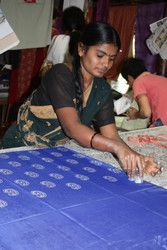
Understanding Jamdani Weaving
Tracing the mathematical precision and multi-stage dyeing processes that define this ancient union weaving craft.
Read More →
Stories of craft, weave, and the artisans who keep tradition alive.
Tracing the mathematical precision and multi-stage dyeing processes that define this ancient union weaving craft.
Read More →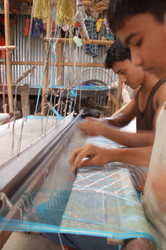
The multi-layered tradition and multi-stage dyeing process that make Ajrakh one of India's most intricate craft forms.
Read More →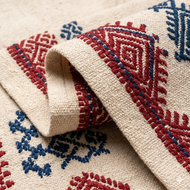
Crafts
Meaning & Origin: Named after the temple town of Kanchipuram in Tamil Nadu. Known as the "Queen of Silks." The Process: Woven from heavy, pure mulberry silk and pure gold/silver zari. It famously utilizes the Korvai technique, where the border an
Read More →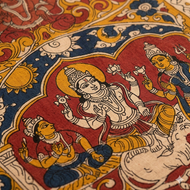
Crafts
Meaning & Origin: Translates to "pen work" (kalam = pen, kari = craftsmanship). Rooted in Andhra Pradesh (Srikalahasti and Machilipatnam). The Process: Artisans use a bamboo pen wrapped in cotton to draw intricate mythological motifs or nature-in
Read More →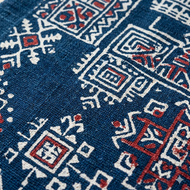
Crafts
Meaning & Origin: Believed to mean "keep it today" (aaj rakh) or derived from the Arabic word for blue (azraq). Practiced by the Khatris in Kutch, Gujarat, and Sindh. The Process: A staggering 14-to-16-step process of resist-printing and natural
Read More →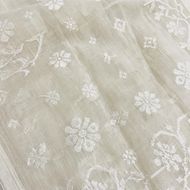
Crafts
Meaning & Origin: From Persian roots (Jam meaning flower, Dani meaning vase). It is a historically royal weave originating in undivided Bengal. The Process: Often described as "loom embroidery," Jamdani is woven using a discontinuous weft techniq
Read More →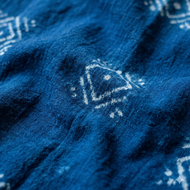
Crafts
Meaning & Origin: Named after Indigofera tinctoria, the plant from which this deep blue natural dye is extracted. India is the oldest center of indigo dyeing. The Process: The leaves are fermented in vats to release the dye. The fabric is dipped
Read More →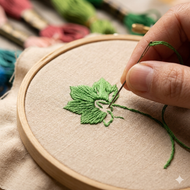
Crafts
Meaning & Origin: An umbrella term for decorating fabric using a needle and thread, with ancient roots across the Indian subcontinent (encompassing Zardozi, Kantha, Phulkari, and more). The Process: Artisans stretch the fabric taut on a wooden fr
Read More →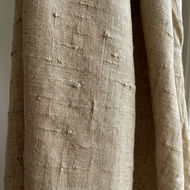
Crafts
Meaning & Origin: Gicha is the coarse, wild silk yarn obtained from the unreeled cocoons of Tussar silk. It is predominantly woven in the tribal belts of Chhattisgarh, Bihar, and Bengal. The Process: While fine silk is reeled in continuous thread
Read More →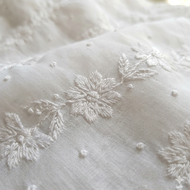
Crafts
Meaning & Origin: Believed to have been introduced by Nur Jahan, the Mughal Empress, Chikankari translates to "embroidery." It is the pride of Lucknow, Uttar Pradesh. The Process: It begins with block-printing a pattern onto sheer fabric (like mu
Read More →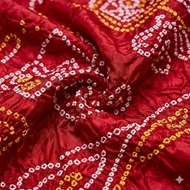
Crafts
Meaning & Origin: The word comes from the Sanskrit 'banda', meaning "to tie." It originated in the Indus Valley Civilization but is profoundly rooted in Gujarat and Rajasthan (specifically practiced by the Khatri community). The Process: This is
Read More →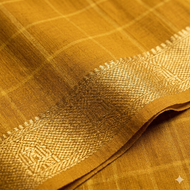
Crafts
Meaning & Origin: Gaji is a luxurious, satin-weave silk known for its rich, glossy texture. It is historically woven and utilized in Gujarat. The Process: Unlike standard plain weaves, Gaji is woven with a satin structure, meaning the silk warp t
Read More →